For the last two decades, e-commerce has been designed for human eyes: colourful banners, persuasive copywriting, and “Buy Now” buttons strategically placed to capture attention. However, a profound shift is underway. We are entering the age of agentic commerce—a digital economy where your next high-value customer may not be a human, but an AI shopping agent acting on their behalf.
Google’s recent introduction of the Agent Payments Protocol (AP2) and its adoption of the Model Context Protocol (MCP) mark the beginning of this transition toward AI-powered e-commerce.
Especially for WooCommerce, Shopify and Magento merchants, understanding these concepts is no longer just technical trivia; it is the foundation of future business strategy.
This following article explains the new technologies, helping you prepare your business for the agentic AI shopping experience and the rise of machine shoppers.
The Agentic Customer: Understanding the AI Shopping Agent
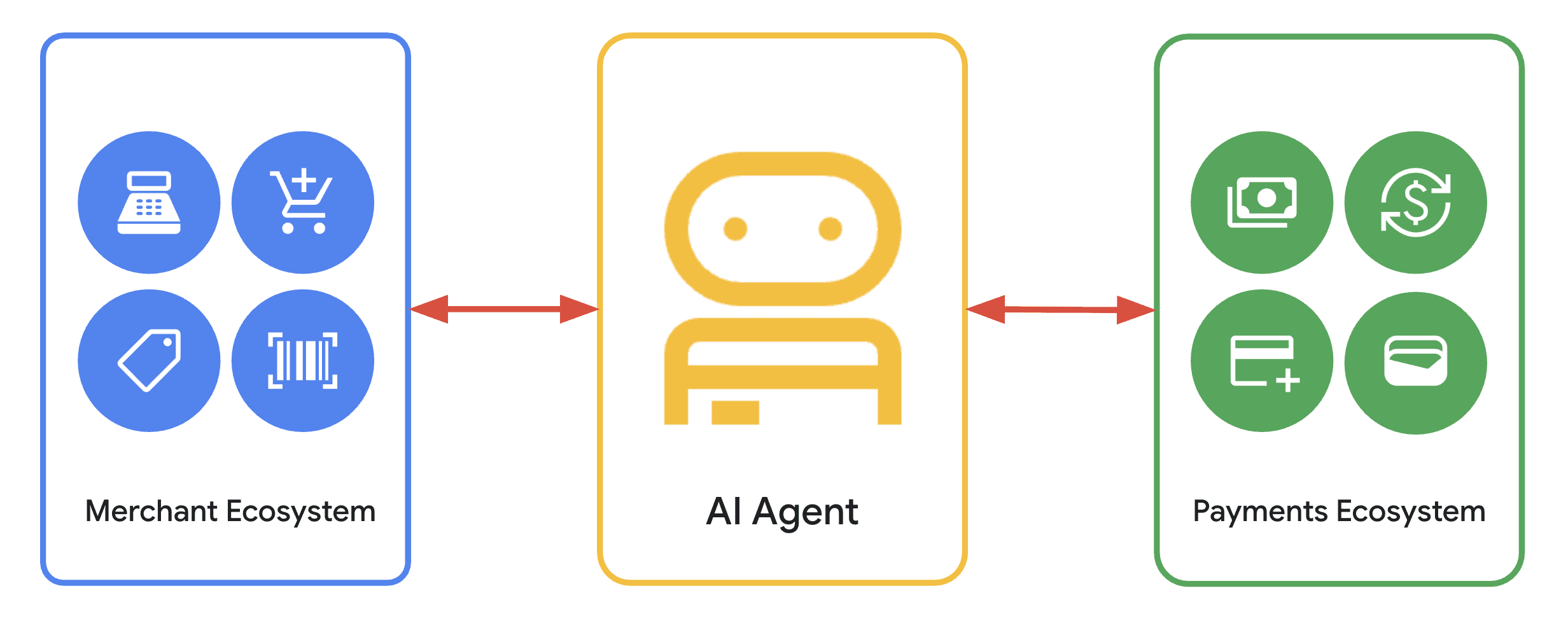
To understand the tools, one must first understand the user. An AI agent is software that can reason, plan, and execute tasks autonomously. Unlike a passive chatbot that simply answers questions, an agent has “agency”—the ability to browse the web, compare prices, and, crucially, spend money on behalf of users.
In this new paradigm of agentic commerce, your e-commerce store is not just a destination for humans; it is a database for AI shopping agents. This requires a shift in how we optimise our online presence, moving from traditional SEO to Agent Engine Optimisation (AEO), also known as agentic SEO.
What is Agent Engine Optimisation (AEO)?
Traditional Search Engine Optimisation (SEO) is about ranking for keywords to earn a human click. Agent Engine Optimisation (AEO) is about structuring data so an AI can “understand” your product without ambiguity—a critical component of generative engine optimization.
SEO Focus: “Best summer running shoes 2026” (Blog posts, emotional imagery).
AEO Focus: Logic and purity. (Exact weight, material composition, precise shipping windows, stock levels).
If your product data is trapped in “fluffy” marketing descriptions, an AI shopping agent may bypass your store for a competitor whose data is easier to machine-read. AEO ensures your store is the “path of least resistance” for an AI buyer in the emerging agentic commerce landscape.
The Universal Language: Model Context Protocol (MCP)
If an AI agent is visiting your store, how does it “read” your products? It does not look at your website’s visual theme. It looks for a standardised data stream. This is where the Model Context Protocol (MCP) comes in.
MCP is an open standard, adopted by Google and other tech leaders, that allows AI models to connect directly to data sources (like your e-commerce platform inventory) safely as well as securely—enabling true AI-powered e-commerce interactions.
The Concept of “MCP-UI” in Agentic Commerce

Despite the most disruptive concept for merchants in the agentic commerce era is MCP-UI. Currently, you expect customers to come to your website to shop. With MCP-UI, the “shopping experience” becomes portable through conversational commerce.
The Old Way: You find a pair of boots you like. You copy the link, paste it into the chat, and your friends click it. They are redirected to a browser, have to log in, search for their size, and navigate a 5-step checkout.
The MCP-UI Way (Agentic Commerce): You drop a line “Find me a pair of white sneakers under 5k.” into the chat. Because the chat app supports MCP-UI, a mini-version of the store’s interface renders directly inside the chat window through conversational commerce.
Imagine you are in a group chat on a platform like WhatsApp or Slack, discussing a hiking trip with friends.
Surprisingly, you or your friends can select their size, see real-time stock, and click “Checkout or Buy Now” using their saved chat credentials—without ever closing the conversation or opening a browser. The AI shopping agent handles the entire transaction seamlessly.
Your e-commerce website is no longer a showcase; it is a set of digital components that travel to the customer, powered by machine shoppers.
The Trust Gap: Google’s Agent Payments Protocol (AP2)
At the heart of agentic commerce is the ‘black box’ nature of complex algorithms. For machine shoppers to spend money at scale, humans must first believe that the underlying logic is not only secure but also consistently aligned with organisational interests and ethical standards.
- How does a merchant know a bot is authorised to spend ₹5,000?
- How does the user know the bot would not drain their bank account?
Undoubtedly, Google’s solution is the Agent Payments Protocol (AP2)—a cornerstone of secure AI-powered e-commerce.

AP2 is a standard that replaces the traditional credit card checkout form with a system of Cryptographic Mandates. Think of a mandate as a digital, tamper-proof letter of permission.
The Chain of Mandates in Agentic Commerce
The AP2 process works through a secure “handshake” that happens in milliseconds:
- The Intent Mandate: Firstly, The human user tells their AI agent, “You are authorised to spend up to ₹5,000 on white sneakers shoes.” This creates a signed digital certificate.
- The Cart Mandate: The AI shopping agent browses your e-commerce store, selects the items, and “locks” the price as well as the stock. It creates a secondary certificate linking the specific products to the user’s spending limit.
- The Payment Mandate: Finally, the machine shopper presents the completed proof to your payment processor. The funds are released instantly.
Why This Matters for Merchants in Agentic Commerce:

- Zero Fraud Liability: Because the mandate is cryptographically signed by the user’s device (e.g., their Google Wallet), it is mathematically impossible for the bot to “go rogue.”
- Frictionless Checkout: There are no forms to fill out. The sale happens in the background, drastically reducing cart abandonment—a key benefit of AI-powered e-commerce.
The Agentic Commerce Shift: Optimising for Machine Intelligence
The transition to agentic commerce will not happen overnight, but the infrastructure is being laid now. To ensure your e-commerce business is ready for AI shopping agents and machine shoppers, focus on these three pillars:
- Data Purity (AEO): Audit your product catalogue. Ensure attributes like size, colour, and dimensions are stored in structured fields, not just written in the description text. This is essential for agentic SEO and generative engine optimization.
- API Readiness: Ensure your store’s REST API is robust. AI agents consume APIs, not HTML pages. Slow APIs will lead to agents “timing out” and abandoning your store.
- Payment Evolution: Monitor your payment gateway providers (such as Stripe or PayPal) for updates regarding “AP2 support” or “Agentic Payments.” This functionality will likely be rolled out via plugin updates in the coming year.
Preparing for AI-Powered E-commerce: The Next Step for Your Business
The shift to agentic commerce represents a new revenue channel—one where the customer is logical, efficient, and ready to spend. As AI shopping agents and machine shoppers become the norm, businesses that embrace Agent Engine Optimisation, adopt conversational commerce through MCP-UI, and implement secure payment protocols like AP2 will gain a significant competitive advantage.
The future of retail is not just digital—it’s agentic. The question is not whether AI-powered e-commerce will transform your industry, but whether your business will be ready when agentic AI customers arrive at your digital doorstep.



Comments
Felt something? How about posting a comment below…