
Coding agents still need human cleanup on most tasks, because they finish parts of a job, not the whole job. In one real-world test, the best agent fully completed only about a quarter of its tasks. So, treat agent output as a strong first draft, then review it like any other code.
Key Takeaways
- Coding agents are fast, but rarely finish complex work alone.
- Partial work can look complete at first glance.
- Human review turns agent output into shippable code.
- Clear tasks and tests raise success rates.
What the Coding Agents Test Found
Researchers from Alibaba and several Asian universities built a benchmark of real-world coding tasks. Then, they ran leading coding agents through it. The best agent fully completed just 26.4% of tasks. In other words, nearly three in four tasks still needed a developer.
Why Coding Agents Fall Short
Missing Context
Agents see only the files you share. As a result, they miss how one change affects the rest of the project.
Confident Output
Agent code often looks clean and complete. However, it can skip edge cases quietly.
Partial Fixes
An agent may solve the main task, then leave loose ends. For example, a new form might work but skip validation.
Shifting Requirements
Real projects change mid-task. Meanwhile, agents follow the prompt, not the client’s evolving intent.
What Human Cleanup Looks Like
Cleanup does not mean rewriting everything. Instead, a developer checks, tests and tightens the agent’s work.
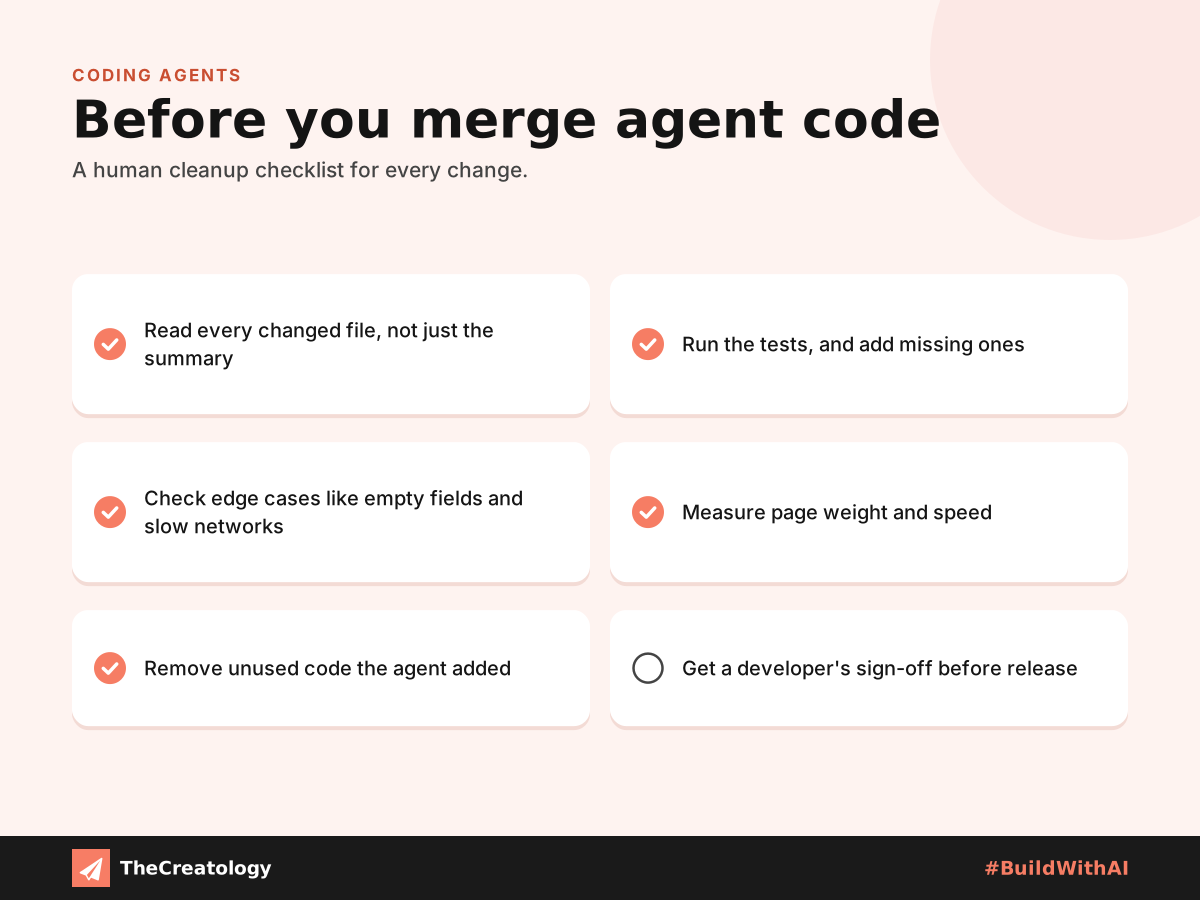
- Read every changed file, not just the summary.
- Run the tests, and write them where none exist.
- Check edge cases, such as empty fields and slow networks.
- Measure page weight and speed after the change.
- Remove any unused code the agent added.
Otherwise, agent code can quietly add hidden performance debt to your pages.
Where Coding Agents Genuinely Help
None of this means you should avoid them. In fact, coding agents shine at repetitive work. They write boilerplate in seconds, draft tests quickly and explain unfamiliar code clearly. They also spot simple bugs a tired developer might miss. As a result, developers spend less time typing and more time thinking. The trick is giving each side the work it does best. Agents handle volume, while people handle judgement, context and final quality.
How to Get More From Coding Agents
Better input brings better output. First, split big jobs into small, clear tasks. Next, share the relevant files and rules up front. Then, ask the agent to write tests alongside its code. Finally, keep a developer in the loop for every merge.
PageSpeed tip: After any agent-written change, run a mobile PageSpeed test. Extra scripts often slip in unnoticed.
Coding Agents: Common Questions
Will coding agents replace developers?
Not soon. For now, they speed developers up rather than replace them.
Are coding agents safe for client projects?
Yes, with review. Never ship agent code that no person has read.
Which tasks suit coding agents best?
Small, well-defined jobs, such as boilerplate, tests and simple refactors.
How much time do coding agents really save?
It depends on the task. On small, clear jobs, they save hours. On large features, review time can eat up much of the gain.
In short, let intelligent tools write the draft, and let developers ship the code.
Want intelligent tools and human developers on your project together? Talk to TheCreatology and #BuildWithAI.




Comments
Felt something? How about posting a comment below…