“Crawled, currently not indexed” means Google visited your page but chose not to show it in search, and Google now says this is common. It does not automatically mean your site is broken. However, if important pages carry this status, they need more value, better links or a clear decision.
Key Takeaways
- Google updated its guidance on this status.
- Many sites have some pages in this state.
- Only pages that matter to your business need action.
- Each page should be updated, merged or retired.
What Does “Crawled, Currently Not Indexed” Mean?
Crawled, currently not indexed: a status in Google Search Console. Google fetched the page, then decided not to add it to search results for now.
You will find it in the Page indexing report. Notably, Google recently updated this help page. It now explains that the status is common and does not automatically signal a problem.
Why Google Skips Some Pages
Google cannot index everything. Instead, it chooses pages it believes help searchers most. As a result, it often skips pages that look thin, repetitive or outdated.
Thin Content
Short pages with little original value rarely earn a place in the index.
Near Duplicates
Tag pages, archives and similar posts often compete with each other.
Weak Links
Pages with few internal links look unimportant, even to Google.
When Should You Worry?
Worry only when the page matters. For example, a service page, a key guide or a product page should be indexed. On the other hand, an old tag archive or a thank-you page can safely stay out. So, start by sorting pages into “must index” and “does not matter”.
How to Fix Pages That Matter
Every important page needs one of three decisions.
- Update: rewrite the page with fresh, useful detail, and keep the same address.
- Merge: combine similar pages into one stronger page, then redirect the rest.
- Retire: remove pages with no value, and return a clear “gone” response.
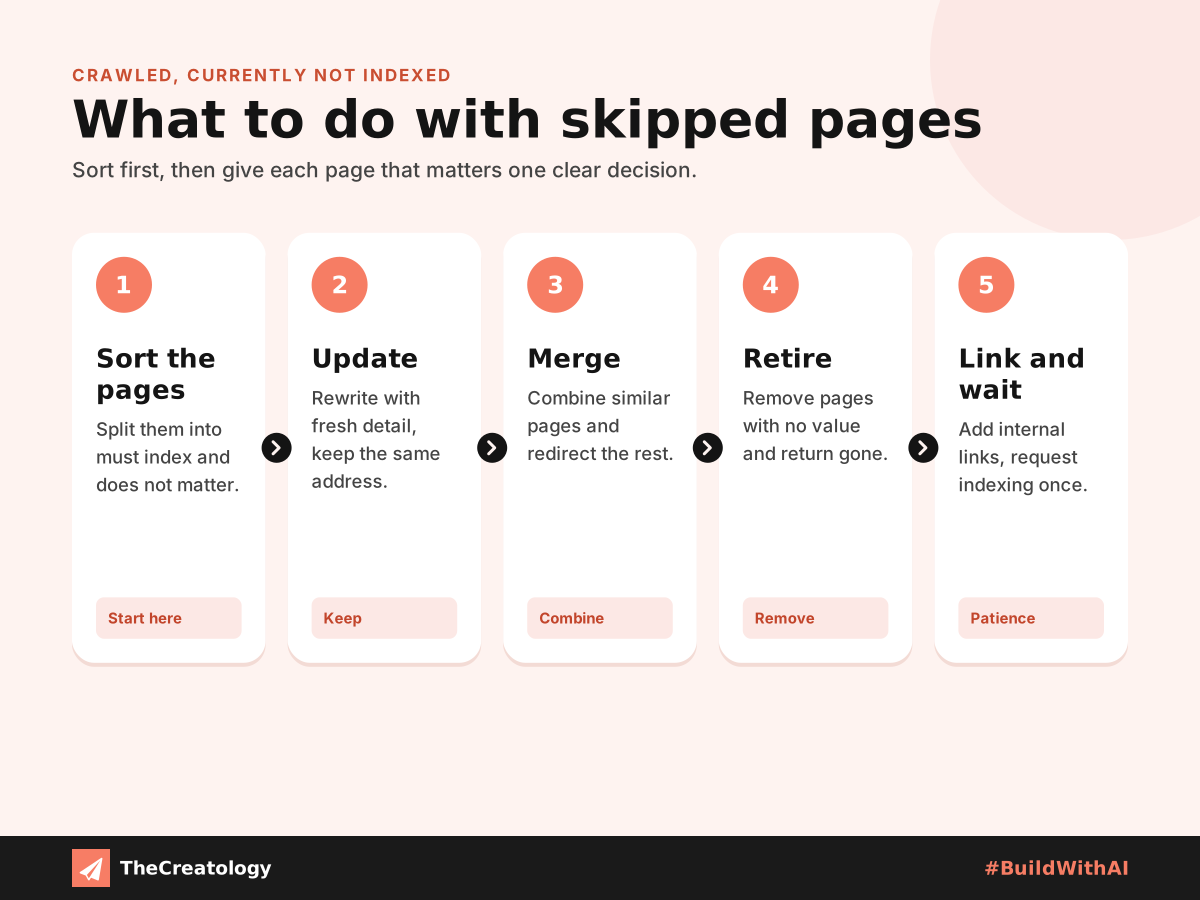
After that, link to the updated page from related posts. Even category pages with a proper description can lift their chances. Finally, request indexing once, then give Google time.
Avoid this: Do not redirect many old pages to your homepage. Google can treat that as a sign of unresolved technical problems.
Why Older Blogs See It Most
Older blogs often see this status most. Years of short news posts, tag archives and outdated tutorials pile up. Over time, they dilute the pages that really matter. So, a regular content audit helps. Review old posts each quarter, and decide whether each one still earns its place. In fact, removing weak pages can lift the strong ones, because Google sees a clearer, more useful site.
Crawled, Currently Not Indexed: Common Questions
Is “Crawled, currently not indexed” a penalty?
No. It is a choice Google makes about each page, not a punishment for the whole site.
How long until a fixed page gets indexed?
It varies. Usually, Google recrawls updated pages within days or weeks, though indexing is never guaranteed.
Should I request indexing again and again?
No. One request is enough. Repeated requests do not speed anything up.
Do category and tag pages need indexing?
Only if they add value. A category page with a helpful description can earn its place, while thin tag pages rarely do.
In short, fix the pages that matter, and let the rest go.
Want help sorting which pages to update, merge or retire? Talk to TheCreatology and #BuildWithAI.




Comments
Felt something? How about posting a comment below…