
Is AI killing Stack Overflow? Not completely, but it is draining the site of new questions and answers. Developers now ask AI tools first, so far fewer problems are solved in public.
In short: public coding knowledge is drying up, and that affects every developer and every AI tool that learns from it.
Key Takeaways
- Stack Overflow activity fell by about a quarter within six months of ChatGPT’s launch.
- Both beginners and experts are posting less.
- AI tools learned from public answers, so fewer answers may weaken them.
- Smart teams are starting to keep their own knowledge instead.
What the Research Says
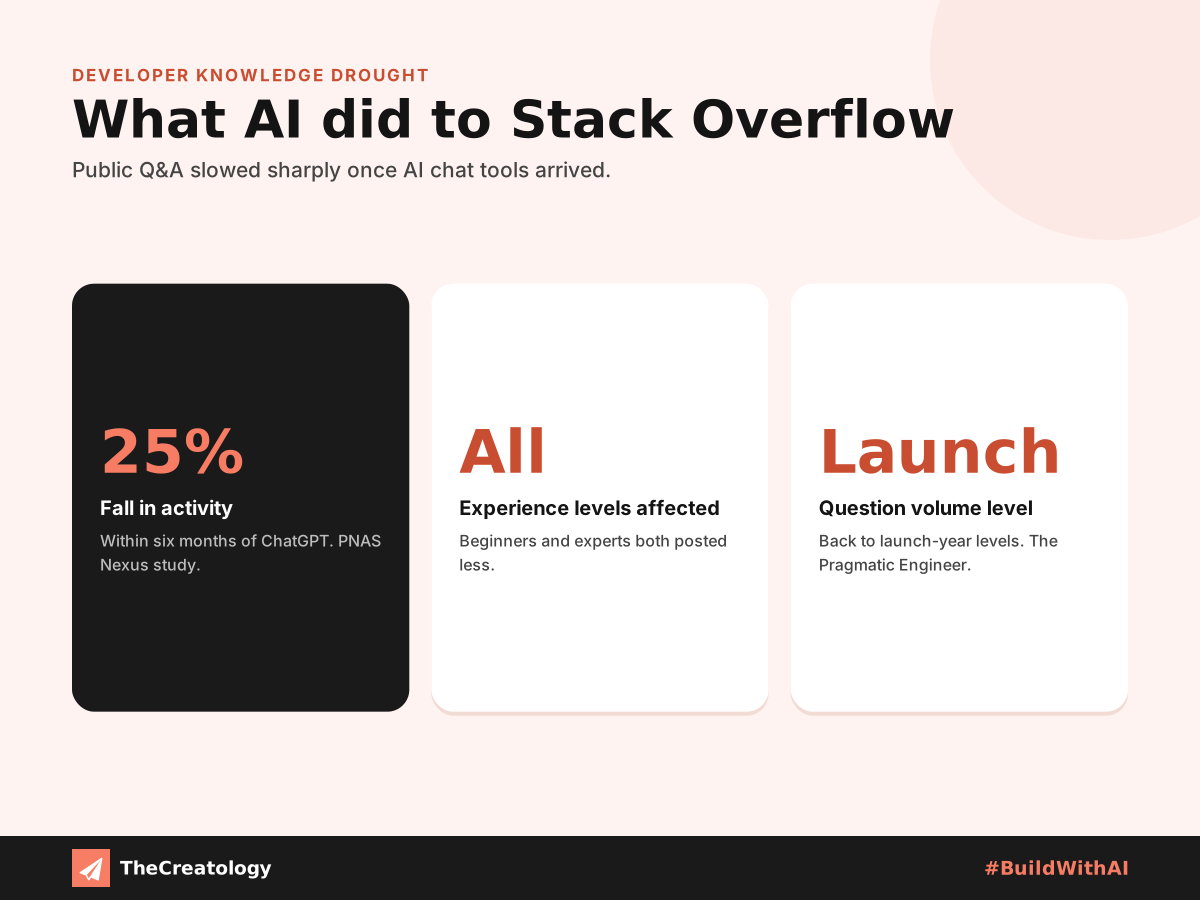
A peer-reviewed study in PNAS Nexus measured the change. It found Stack Overflow activity dropped by 25% within six months of ChatGPT’s release. Moreover, the fall was steeper for popular languages such as Python and JavaScript.
Similarly, The Pragmatic Engineer reported that new questions have fallen back to the levels seen when the site first launched. However, the decline did not start with AI alone. Stricter moderation had already slowed growth for years. Instead, AI simply sped up the drop.
Why Developers Stopped Posting
The reason is simple. An AI tool answers in seconds, never closes your question and never judges it. As a result, asking strangers online feels slow by comparison. In addition, AI tools can read your exact error and suggest a fix straight away.
The Hidden Cost: A Knowledge Drought
Definition: a knowledge drought is when fewer people share solutions in public, so less fresh knowledge exists for others to learn from.
AI tools learned to code by reading public answers. Therefore, if developers stop posting, the tools have less new human knowledge to learn from. The study’s authors warn this could shift knowledge from public spaces into private systems.
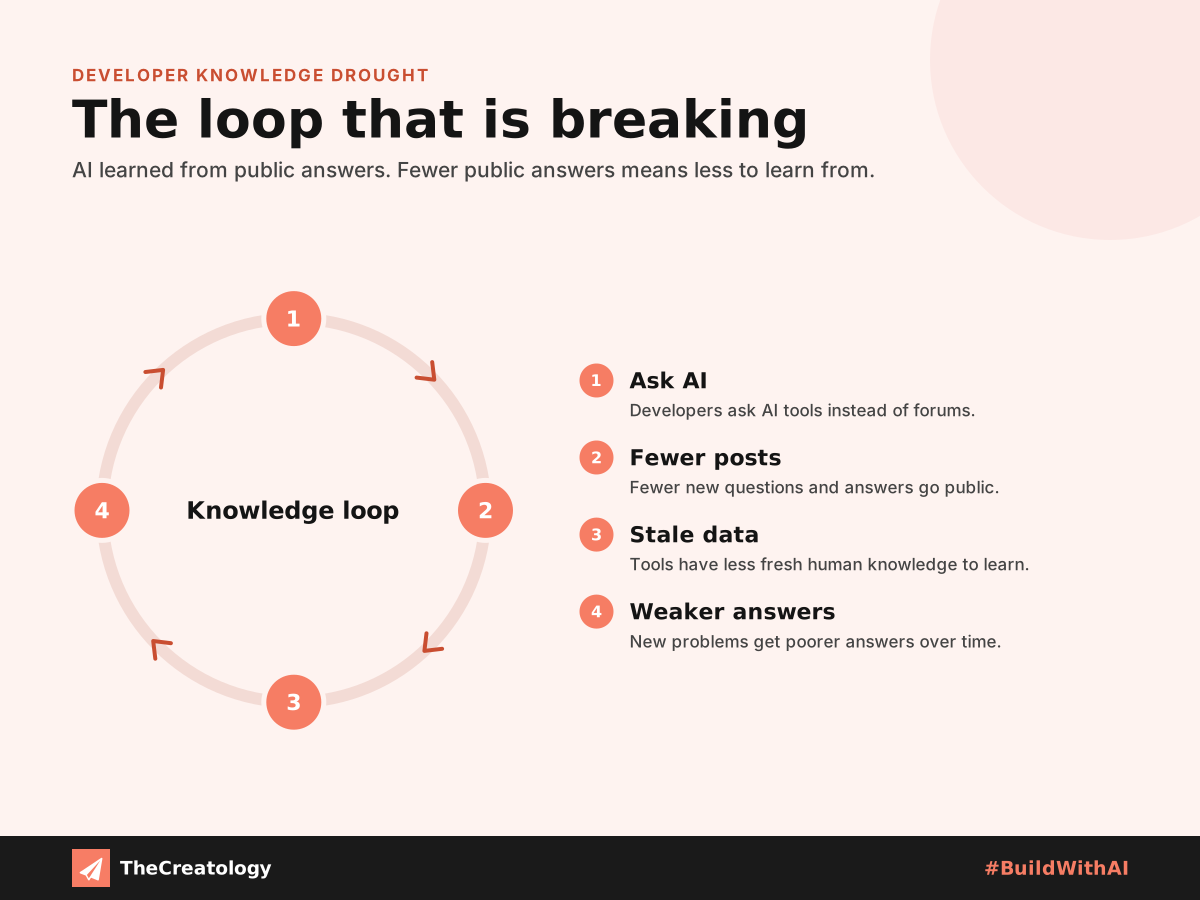
Consequently, brand-new problems, such as a fresh framework bug, may get weaker answers. After all, nobody has written about them in public yet.
What This Means for Your Team
For most teams, the answer is not to abandon AI tools. Rather, it is to stop relying only on public knowledge. Your own fixes, decisions and project notes are now far more valuable. Indeed, they are knowledge no public forum or rival can offer.
Next step: start a simple fix log today. Record each problem, its cause and the fix your team used.
How Development Teams Can Respond
So, if AI is killing Stack Overflow as a place to ask new questions, what should teams do? First, keep using AI tools, because they genuinely save time. However, record the answers that actually worked on your projects. Additionally, write down the reasoning behind important technical decisions.
Furthermore, consider sharing selected solutions publicly, for example on your company blog. This strengthens your reputation and keeps valuable knowledge discoverable. Ultimately, the developers who document consistently will understand their systems far better than those who simply copy suggestions.
Is AI Killing Stack Overflow? Common Questions
Is Stack Overflow shutting down?
No. The site is still online and its archive remains useful. However, far fewer new questions are being asked.
Did AI cause the whole decline?
No. Questions were already falling because of strict moderation. Even so, AI tools made the decline much faster.
Will AI coding tools get worse?
Researchers warn they could struggle with new problems if public sharing keeps falling. That is why private team knowledge matters more now.
To see how intelligent tools connect to your own systems, read our guide to the Model Context Protocol.
Public answers are fading. The teams that keep their own knowledge will lead.
Want to build a knowledge base your tools can learn from? Talk to TheCreatology and #BuildWithAI.




Comments
Felt something? How about posting a comment below…