
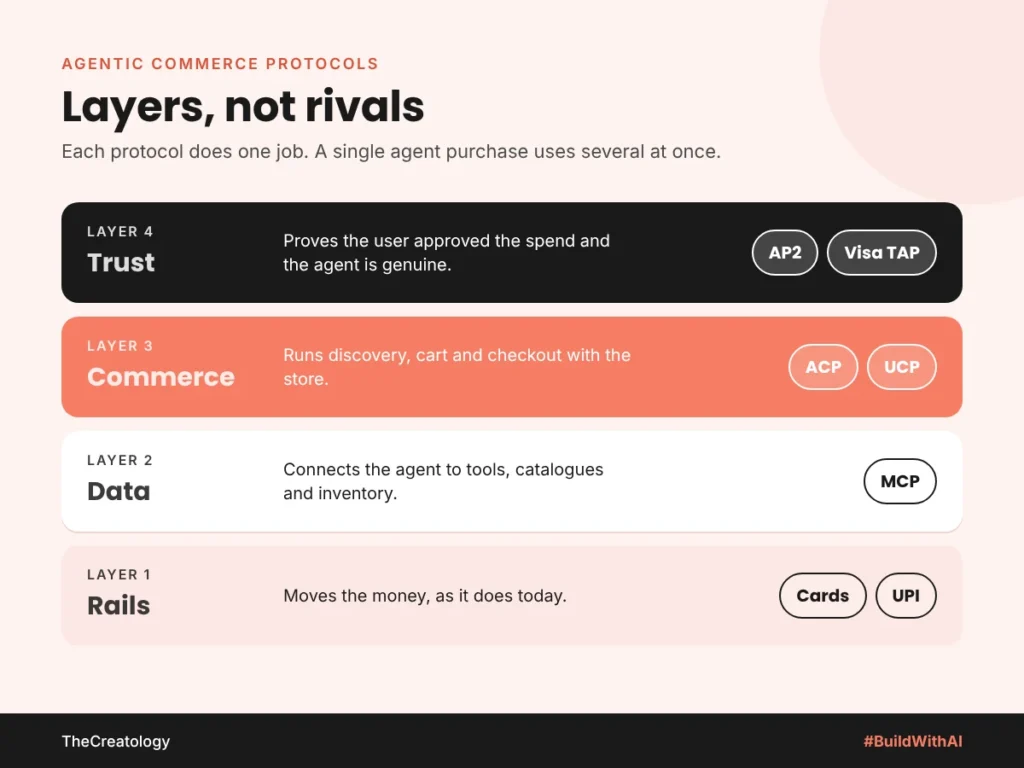
Agentic commerce protocols are the shared rules that let AI agents find products, check out and pay. The main ones are ACP, UCP and AP2, with MCP underneath. Importantly, they are layers that work together, not rivals you must choose between.
Key Takeaways
- MCP connects agents to data and tools.
- ACP and UCP run the shopping and checkout.
- AP2 and Visa TAP prove the payment and the agent are genuine.
- Most stores will support several, often through their platform.
The Data Layer: MCP
Definition: MCP (Model Context Protocol) is an open standard that connects an AI agent to tools and data.
Anthropic released MCP in November 2024. Since then, it has become the common plug for agents. However, MCP is not a shopping protocol on its own. Rather, it is how an agent reaches one. Read our MCP guide for more.
The Commerce Layer: ACP and UCP
ACP: Agentic Commerce Protocol
OpenAI and Stripe launched ACP in September 2025 to power Instant Checkout inside ChatGPT. However, in March 2026, ChatGPT shifted its focus to product discovery. Now, buyers often finish on the store’s own checkout. Even so, ACP still helps carry product feeds into ChatGPT.
UCP: Universal Commerce Protocol
Google and Shopify announced UCP in January 2026. It covers the whole journey, from discovery to checkout and orders. Moreover, it runs over REST, MCP or A2A. It powers buying in Google’s AI Mode and Gemini.
The Trust Layer: AP2 and Visa TAP
Trust needs its own layer. First, AP2 (Agent Payments Protocol) from Google uses signed mandates. These prove the user approved the spend. Second, Visa’s Trusted Agent Protocol (TAP) checks the agent’s identity. Together, they separate good agents from bad bots.
How the Layers Work Together in One Purchase
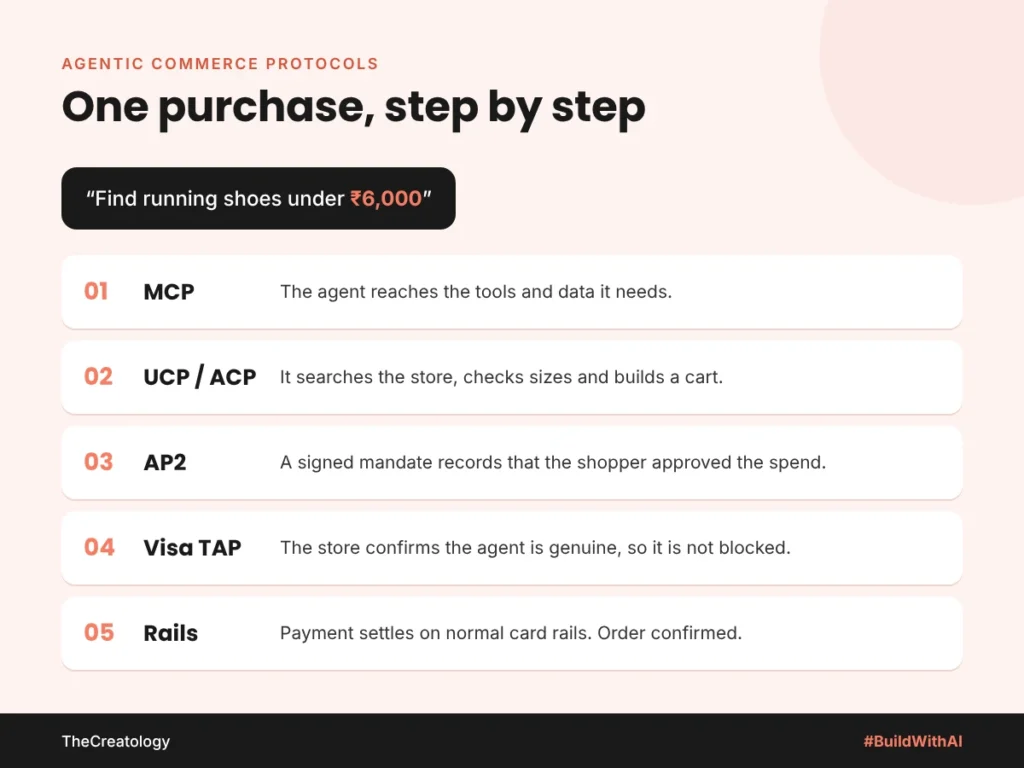
Picture a shopper asking Gemini for running shoes under ₹6,000. First, the agent uses MCP to reach the tools it needs. Next, UCP lets it search the store, check sizes and build a cart.
Then, AP2 records that the shopper approved the spend. Meanwhile, Visa TAP confirms the agent is genuine, so the store does not block it. Finally, the payment settles on normal card rails.
In other words, each protocol does one job. Consequently, every store needs clean data underneath them all, because every layer reads the same product facts.
Agentic Commerce Protocols Compared
| Protocol | Led by | Launched | Job |
|---|---|---|---|
| MCP | Anthropic | Nov 2024 | Connects agents to data |
| ACP | OpenAI, Stripe | Sep 2025 | Feeds and checkout for ChatGPT |
| UCP | Google, Shopify | Jan 2026 | Discovery to orders |
| AP2 | 2025 | Proves payment consent | |
| TAP | Visa | Oct 2025 | Verifies agent identity |
Which Protocol Should Your Store Support?
Usually, your platform decides for you. For instance, Shopify brings ACP and UCP to its merchants. Meanwhile, Visa Intelligent Commerce Connect accepts ACP, UCP and TAP through one integration.
- Shopify stores: turn on the agentic channels in your admin.
- WooCommerce stores: watch your gateway for ACP or UCP plugins.
- Everyone: fix product data first, because every protocol reads it.
Next, see the full picture in our guide to agentic commerce and AI shopping agents.
Agentic Commerce Protocols: Common Questions
Are ACP and UCP competitors?
Partly. They do similar jobs on different platforms. Even so, Google says UCP can coexist with ACP.
Do I need to write protocol code?
Rarely. Most merchants gain support through Shopify, Stripe or their payment gateway.
Is MCP a payment protocol?
No. MCP only connects agents to tools. Payments run through ACP, UCP and AP2.
Which protocol matters most in India?
It depends on where your buyers shop. For example, ChatGPT users reach stores through ACP, whereas Google users reach them through UCP. In addition, watch NPCI’s plans for AI agents on UPI.
In short, MCP connects, ACP and UCP sell, and AP2 and TAP protect.
Need help making your store agent-ready? Talk to TheCreatology and #BuildWithAI.



Comments
Felt something? How about posting a comment below…