It is 3 a.m. in 2031, and superintelligence for business is about to prove its worth. A port strike has just frozen all shipments for a small drone-parts maker. The company exports to thirty countries with only fourteen staff. Its founder, meanwhile, is three weeks into a mountain trek with no signal.
Nobody panics. Instead, the company’s superintelligence moves the cargo to air freight within minutes. Next, it agrees new delivery dates with a major defence buyer. It also hires a stand-in engineer and updates the quarterly forecast. By dawn, every client has a fresh timeline. Consequently, the founder returns to a two-line summary and a record month.
Yet it all began years earlier, with one bold decision. She chose to replace herself.
Key Takeaways
- Superintelligence can run a company, not just assist the founder.
- Founders hand over control in four stages: codify, shadow, command and succession.
- A written owner charter keeps every decision within safe limits.
- Start now by recording ten decisions a week.
The Founder Was Always the Bottleneck
Every growing company hits the same wall. Simply put, too many decisions wait for one person. Hiring managers helps, yet it adds cost and slows things down. In contrast, superintelligence for business removes that wall for good. It does not assist the founder. Rather, it performs the founder’s job.
What Superintelligence for Business Really Means
Most companies use intelligent tools for small tasks. For example, they draft emails or summarise reports. In our guide to connecting intelligent tools to daily work, we showed how that first step looks.
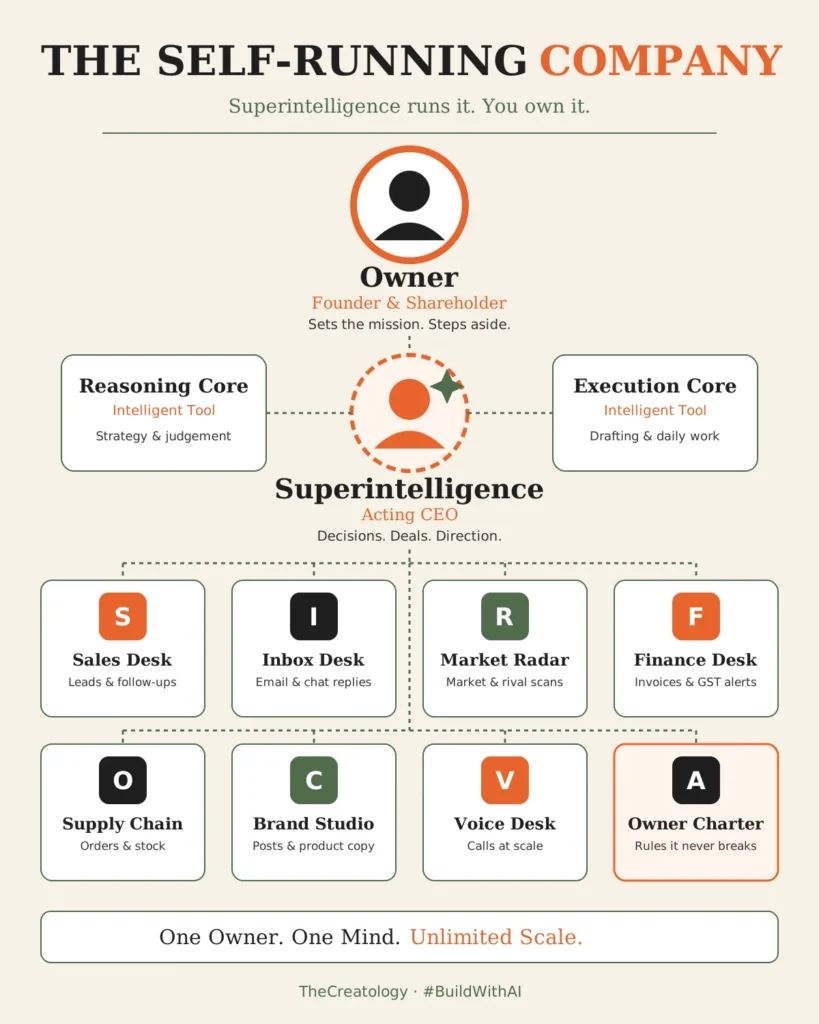
Definition: superintelligence for business is a system that reasons like an owner, weighs trade-offs and acts across every department. Therefore, the founder moves from operator to owner.
From Assistant to Acting CEO
Picture a new org chart. You sit at the top as owner. Below you, the system acts as CEO. Furthermore, it directs intelligent tools for sales, finance, stock and brand.
Owner charter: above all, a written charter sets the rules it must never break.
The Succession Ladder: Four Steps to Replace Yourself
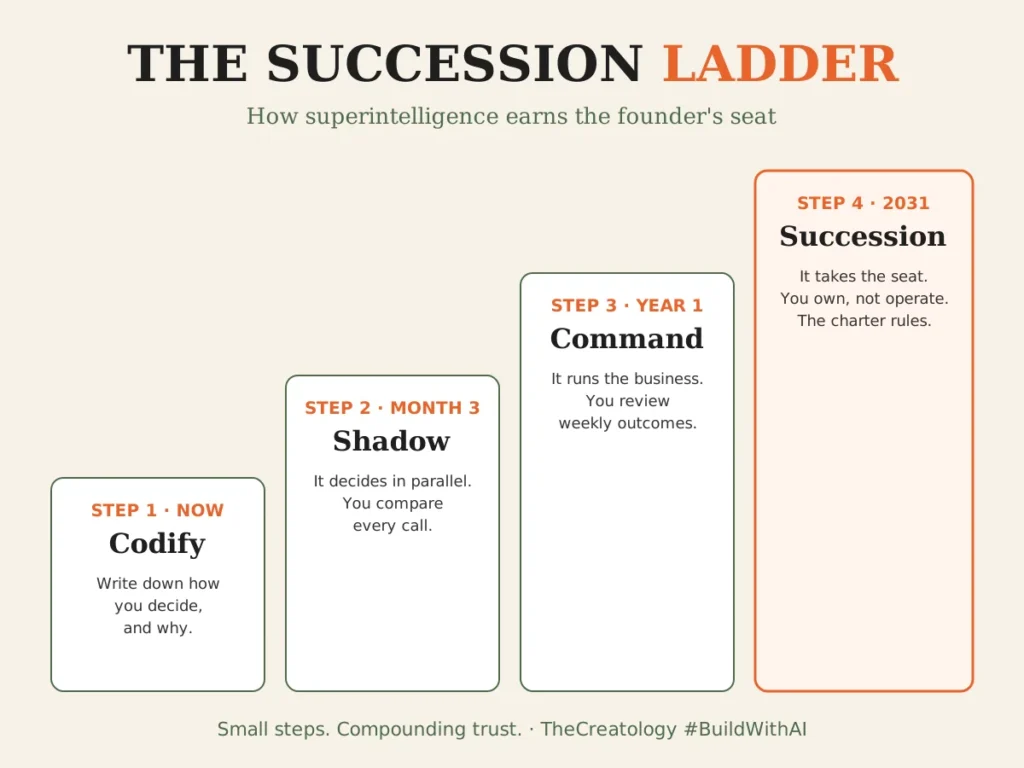
You should never hand over the top seat overnight. Instead, trust grows through four clear stages.
Step 1: Write Down How You Decide
First, record each important decision and the reason behind it. Log your pricing, your hiring and the suppliers you rejected. As a result, your instinct becomes a playbook the system can learn.
Step 2: Run It in Shadow Mode
Next, let the system make every decision alongside you. However, only your choices go live. Then, compare both sets of outcomes each week. The gaps reveal exactly where it needs more context.
Step 3: Hand Over the Keys
Once the gaps close, let it run daily operations. Meanwhile, you review outcomes, not each small step. So your calendar opens up for strategy and new ventures.
Step 4: Take the Owner’s Chair
Finally, it takes the top seat. You remain the owner, while the system runs the company. Your charter, however, still governs every move.
Guardrails Before You Let Go
Still, stepping aside demands discipline. Set firm limits on spending, contracts and hiring. Also, keep a complete record of every decision it makes. Most importantly, keep the choices you cannot undo for yourself.
Start Your Succession Today
The drone-parts founder did not vanish overnight. Rather, she wrote down ten decisions a week for a year.
In short, those who start now will own companies that run without them.
Superintelligence for Business: Common Questions
What is superintelligence for business?
It is a system that makes and carries out decisions across a whole company, guided by the owner’s written rules. Unlike a simple tool, it runs the business rather than one task.
Can a founder really replace themselves?
Yes, but only in stages. Founders who record their decisions and test the system in shadow mode can hand over daily operations safely.
How long does the succession take?
Most firms need one to five years. The pace depends on how well the founder documents decisions and how fast trust builds.
What should the owner never hand over?
Keep any choice you cannot undo. That includes selling the company, large legal deals and changes to the owner charter itself.
Ready to plan your exit from the daily grind? Talk to TheCreatology and #BuildWithAI.



Comments
Felt something? How about posting a comment below…