
We count tokens, track productivity and compare models. Now it is time to count something else: the AI carbon footprint of every chat.
Quick answer: an AI carbon footprint is the electricity, water and carbon emissions behind each AI session. Few firms show users that figure today.
AI is changing how we work, create and run businesses. At TheCreatology, we want this tech to be open to all through #BuildWithAI. But we cannot ignore its cost to the planet. Yet this worry is no longer just theory. Every AI reply relies on real hardware: chips, data centres, power, cooling and water.
So the firms that lead this shift must explain what that hardware costs the planet.
Why is AI carbon footprint data so hard to find?
Look at the biggest names: OpenAI, Anthropic, Google and Meta. Each one shares a different amount of data.
For example, Google has shared research on its Gemini model. It puts a median text prompt at 0.24 watt-hours of power and 0.03 grams of CO₂ equivalent. Google also shared its method, but nobody has checked the estimates independently.
Meanwhile, OpenAI CEO Sam Altman has cited about 0.34 watt-hours per average ChatGPT query. However, the firm has shared no matching method or carbon figure.
Anthropic has yet to publish per-query figures for Claude. Meta shares a lot on its data centres and company-wide impact. Even so, users cannot see the carbon cost of a single AI session.
These firms are investing in cleaner power and better efficiency. That deserves credit. Still, company sustainability reports are no substitute for clear data on each product’s AI carbon footprint.
What if AI showed carbon next to tokens?
There is another contradiction worth questioning. Claude, for instance, has shown users that they have used up to 10 times more tokens than other users. But why compare how much AI people use without showing what that use costs the planet?
Platforms can already measure tokens, track usage and compare individual habits. Surely, they can also work towards showing the estimated electricity, water and carbon emissions behind each session. Users should not only be made aware of how much they consume. They should also understand their own AI carbon footprint.
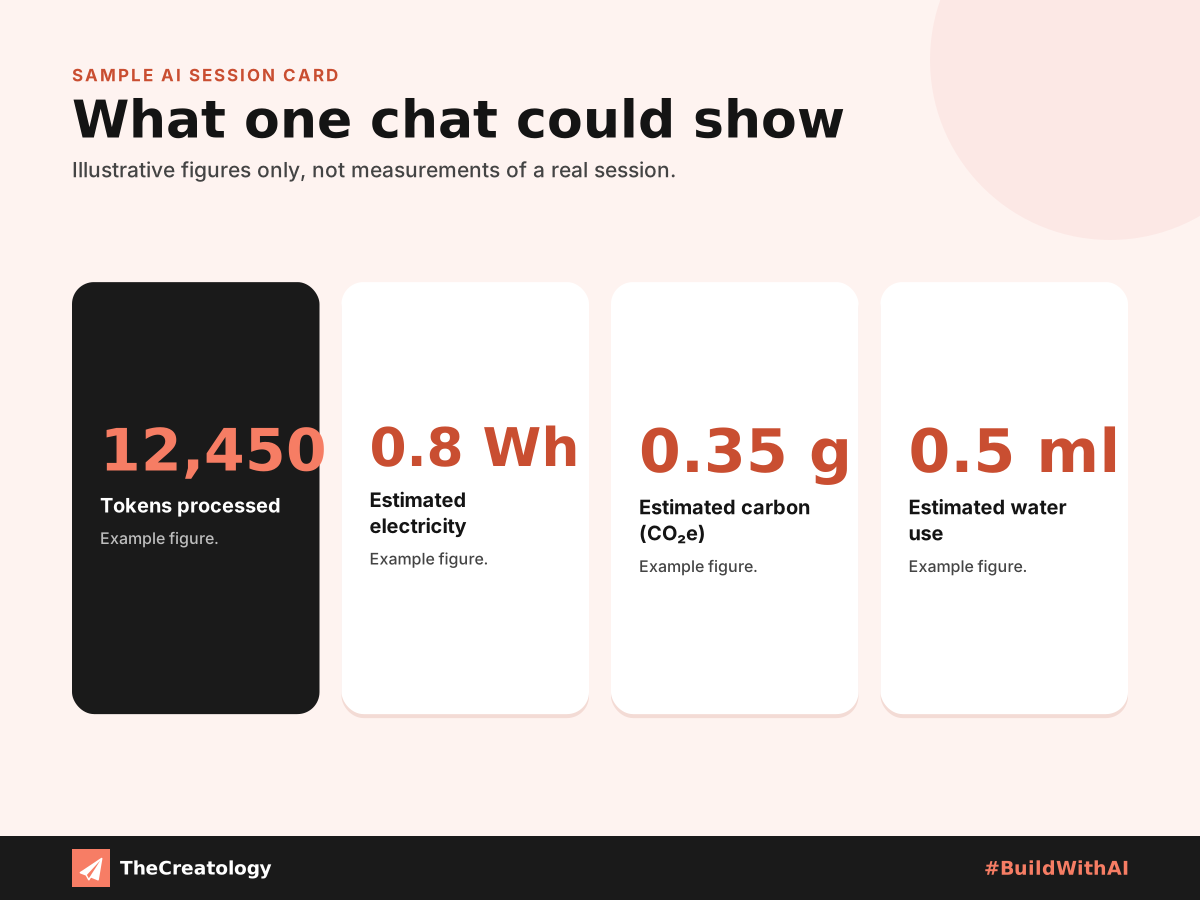
Picture the end of an AI chat. Then imagine you see this:
- Tokens processed: 12,450
- Estimated electricity: 0.8 Wh
- Estimated carbon emissions: 0.35 g CO₂e
- Estimated water consumption: 0.5 ml
Note: these figures are examples only. They are not measurements of a real session.
So why should this not become standard across ChatGPT, Claude, Gemini and Meta AI?
The sums should cover the model, the workload, data-centre efficiency and the power source. Also, image, video and long reasoning tasks need their own measures. Each estimate should state its limits and its uncertainty.
A shared reporting standard would let people make informed choices, rather than simply picking the priciest or most powerful plan.
From digital footprints to green credits
But openness must lead to action.
India, for example, already runs a Green Credit Programme. It rewards verified green acts, including tree planting. Its planting method gives one Green Credit per tree grown, with a minimum of 1,100 trees per hectare under the guidelines.
That works out at about 0.11 trees per square metre. However, planted area alone does not prove carbon removal. Species, survival, soil, local ecology and long-term checks all matter.
What AI firms and users can do
AI firms, tech businesses and even everyday users could back native tree restoration, community forests and verified green-credit projects.
Remember: this should add to cuts in emissions, not replace them. After all, one tree cannot cancel out a data centre’s output at once.
In short, #BuildWithAI means building useful things while keeping the wider world in view.
We do not need to stop using AI. Instead, we need creators who share more, users who think more and growth that is more responsible.
Count the tokens. Show the carbon. Grow something green.
That is a future worth building with AI.
AI carbon footprint: your questions answered
How much power does one AI query use?
Google puts a median Gemini text prompt at 0.24 watt-hours and 0.03 grams of CO₂ equivalent. OpenAI CEO Sam Altman has cited about 0.34 watt-hours per average ChatGPT query. However, OpenAI has shared no carbon figure.
Should AI platforms show carbon next to tokens?
Yes. A shared reporting standard would let people compare products and choose wisely. Each estimate should also state its limits and its uncertainty.
Can planting trees offset AI emissions?
Not on its own. Planting should add to cuts in emissions, not replace them. Species, survival, soil, local ecology and long-term checks all matter.
#BuildWithAI #ResponsibleAI #GreenAI #ClimateAction #TheCreatology




Comments
Felt something? How about posting a comment below…