
How do you teach kids to question AI? Teach them that a shiny answer is not always a true answer. Intelligent tools can be wrong, so children should check before they trust.
This is Part 2 of our Diwali series for Indian parents. Each tip comes from a moment in the Ramayana.
Key Takeaways
- Intelligent tools sound sure, even when they are wrong.
- A curious child is a safe child.
- Five quick checks can catch most mistakes.
- Questioning is a skill, not rudeness.
The Golden Deer Looked So Real
In the forest, Sita saw a beautiful golden deer. It sparkled and danced. Naturally, she wished to have it. However, the deer was not real. It was Maricha in disguise.
Intelligent tools sometimes give golden deer answers. They look perfect and sound very sure. Yet, now and then, they are simply wrong. Therefore, our children need to learn one small habit: look twice.
Simply put: intelligent tools guess the most likely answer. Most of the time it is right. Sometimes, though, it is a confident mistake.
Why Questions Make Children Stronger
In many homes, we teach children not to question elders. That respect is precious. But a tool is not an elder. In fact, asking a tool “are you sure?” is good thinking, not bad manners.
Moreover, children who question tools also learn to question rumours, fake news and tricky messages. So, this one habit protects them far beyond homework.
Tip 2: Ask Before You Accept
Teach your child these five simple checks. Keep them on the fridge if you like.
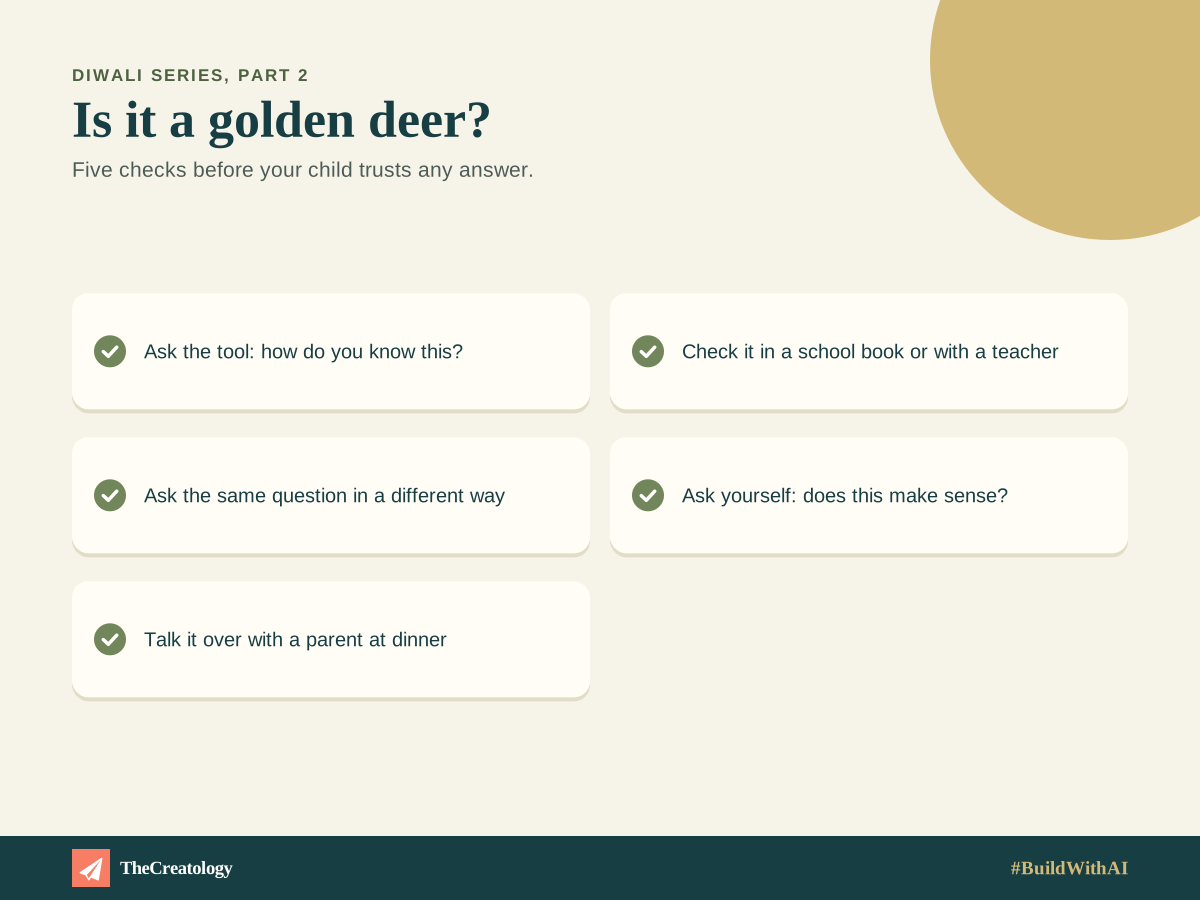
Ask How It Knows
First, ask the tool where the answer came from. A good answer can be explained simply.
Check a Second Source
Next, compare it with the school textbook or ask the teacher. If both agree, wonderful. If not, dig deeper together.
Ask It Again, Differently
Then, ask the same question in new words. If the answer changes a lot, be careful. Finally, talk about it over dinner. Family chats are the best fact checkers.
Try this Diwali: ask a tool a simple question you already know, such as a family recipe. Spot together what it gets right and wrong.
A Habit for Life
When parents teach kids to question AI, they are really teaching them to think. Moreover, this habit grows stronger with every check. Over time, your child will not need reminders. Instead, they will ask “is this true?” on their own. For a closer look at study tools that encourage questions, see our guide to learning with NotebookLM.
Why Critical Thinking Matters Today
Educational specialists increasingly describe critical thinking as an essential, lifelong capability for every generation. Consequently, when parents teach kids to question AI, they strengthen independent reasoning, evaluation and responsible decision-making. Furthermore, international organisations recognise information literacy as fundamental protection for children. For example, UNICEF’s policy guidance on artificial intelligence for children emphasises understanding, transparency and responsible participation.
Of course, these tools can sound very sure, even when they are wrong. So, children need a simple habit of checking, and a family that listens. Talk about where facts come from at the dinner table. In time, your child will ask “how do we know?” without any reminder. That small question is the best shield against false news, tricks and confusion.
Teach Kids to Question AI: Common Questions
Why do intelligent tools make mistakes?
They predict likely answers from what they have read. Sometimes, that prediction is wrong but still sounds confident.
Will questioning confuse my child?
No. Instead, it builds confidence. Children learn that they can think for themselves.
How young can children learn this?
Even young children can learn “let’s check together”. Older children can follow all five checks alone.
Not every golden deer is real. Teach your child to look twice.
Next in the series: the bridge to Lanka, and why children should create with tools, not copy from them. Happy Diwali from TheCreatology.




Comments
Felt something? How about posting a comment below…